Start in 1977. Two probes leave Earth, each carrying a golden record and a computer with less memory than the greeting card that plays a tune when you open it. Forty-odd years later, Voyager 1 and 2 are still out there — past the heliopause, in interstellar space, sending back a whisper of telemetry that takes nearly a day to reach us. The fault-protection logic on board, the routines that decide what to do when something goes wrong with nobody around to ask, is the ancestor of everything I want to talk about. It wasn't called AI. But it was the first time we sent a machine somewhere we couldn't reach and said: you'll have to use your judgement now.
That sentence is the whole story of space, really. The further out you go, the longer the radio takes, and the more judgement you have to hand over. So let me trace the line forward, because it goes somewhere lovely.
Mars, where you simply cannot joystick
Follow the line to Mars and the problem sharpens. The radio round-trip runs up to 22 minutes each way. You can't drive a rover with a controller; by the time your "turn left" arrives, it's already in the crater. So Curiosity and Perseverance carry onboard intelligence that decides, moment to moment, where to drive and what's worth a closer look.
My favourite example is a system on Perseverance called AEGIS. As the rover drives, its computer vision picks out interesting rock formations and — without waiting to ask Earth — swings its laser spectrometer round and fires. Scientists wake up to data about things they never instructed it to study. Things the machine found interesting on its own, alone, on another planet, while we slept.
I find that image genuinely moving. A small, patient, curious thing tens of millions of miles away, deciding what to notice. That's not a replacement for the scientists on the ground. It's a scout in a place we can't easily go.
And then it turns around and looks at us
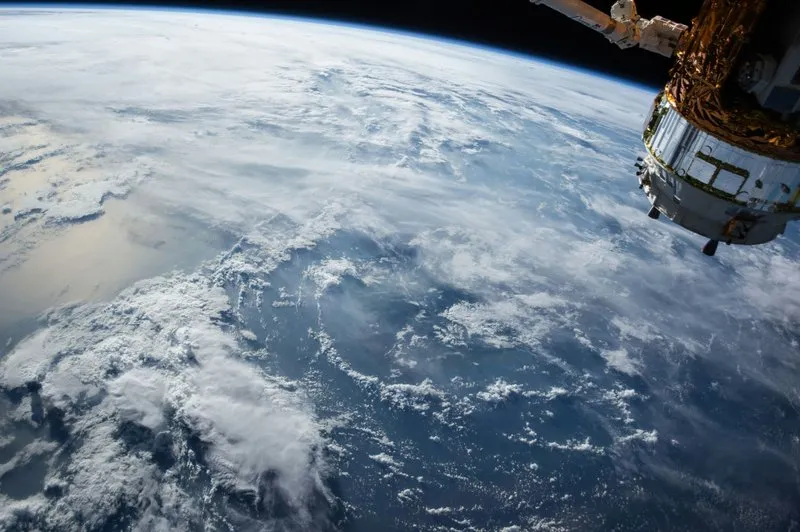
Here's the turn in the story. The same instinct we sent outward came home and pointed back at Earth — and that's where AI in space touches the most lives.
Satellites generate more imagery in a day than any human team could read in a year, so AI now takes the first pass: spotting deforestation as it starts, tracking crop health, catching the early heat signature of a forest fire. Work that used to be months of analyst time finishes overnight.
It watches the oceans, too. Models now pick out ships from orbit — small ones, even at night via thermal imaging — to track illegal fishing, piracy, and the great invisible mass of shipping that runs dark with its transponder off. After an earthquake or a hurricane, humanitarian teams point the same techniques at disaster zones to map which buildings have collapsed and which roads are blocked, fast enough to change where rescuers go. That has saved lives. And up above all of it, AI sifts satellite data for methane plumes, sulphur dioxide over industrial sites, CO₂ off power stations — making climate accountability possible at a scale that simply wasn't practical before.
There's more in between, threaded along the same line. Autonomous docking, where Dragon and others bring two vehicles travelling at 28,000 km/h into contact at a few centimetres per second, vision and learning handling the final approach. Exoplanet discovery, where Kepler and TESS found thousands of worlds because models learned to notice the tiny, periodic dip in a star's brightness as a planet crosses its face. Scheduling assistants squeezing the most science out of brutal power and communication budgets. Fault-diagnosis tools that correlate anomalies across subsystems when an engineer on the ground has only a trickle of telemetry to work from.
Why it's harder up there than in any data centre
It would be dishonest to make this sound easy. Space is a vicious place to run a model.
Radiation eats hardware, so onboard AI runs on modest, hardened processors a fraction as capable as anything on Earth — which forces lean, efficient models, and is often a good thing. You can't patch in flight, not really; missions pick conservative, well-validated models and live with them for years. And the sim-to-real gap is at its most brutal here: you cannot test a Mars rover on Mars before it arrives, so everything trained on simulations and Earth analogues has to generalise to a world it has never seen.
Where the line ends, for now
Trace it all the way through — Voyager's fault logic, AEGIS choosing its own rock, a satellite catching a methane leak nobody reported — and it's one continuous gesture. Humans have always looked up and tried to work out what's there. The machines we've sent are part of that looking now, doing their best to notice things we might want to know about, in places we can't yet stand.
I think that's about the most worthwhile thing a piece of software can be asked to do.
If you're working on anything space-adjacent — or you just want to talk about probes that have been running longer than most marriages — those are some of my favourite conversations. Come and have one.